Critical Fabulation and Reparative Retelling
13th October, 10-1, University of St Andrews (Hebdomadar’s Room)
Collaborative, ‘hands on’ workshop open to research staff and students.

The myths that remain potent today are replete with violent conflict. For millennia they have normalised war and heroised warriors, while gesturing only superficially to war’s aftermath and its alternatives. However, in between the lines of these stories, other narratives can surface. Creative retellings — such as Pat Barker’s Silence of the Girls and Natalie Haynes’ A Thousand Ships — have centred the experiences of characters (mainly women) whose war stories have long been suppressed. Such creative ‘counter narratives’ not only push back against the militarising messaging of the texts that they are responding to; they can also increase our ‘peace literacy’ by helping us explore more deeply what losing, finding, making and preserving peace involves in different contexts. This workshop will explore the potential — and limitations — of ‘reparative retelling’, drawing on related practices in speculative fiction (as theorised by e.g. Ursula Le Guin) and critical fabulation (pioneered by Saidiya Hartman).
This workshop invites participants (staff and students) from a wide range of disciplines (including Classics, English, History, Modern Languages, Film Studies, and International Relations) to come together to explore how creative methodologies can help us better understand the past, reframing our understanding of history as well as myth. Engaging with research on peace storytelling and narrative transformation, we will also consider the role that creative retellings of myth and history can play in deepening understanding of war and peace in the present and driving change for the future.
For more information, or to register, please email [email protected].
Long After the Labyrinth

We will preview a work-in-progress performance of our ‘peace play’, Long After the Labyrinth, on 3rd May 2026, at Upstairs at the Gatehouse, Highgate, London. Tickets can be purchased here.
The play will premiere at the same venue on 19th October, running for three weeks until 8th November. It will then go on tour, with performances at the Byre Theatre in St Andrews (12th November), The Ark, Cliftonville (21st November) and Manchester Jewish Museum (29th November).
We will host a post-show Q&A after some performances, and will offer drama and peace storytelling workshops alongside performances. To find out more, please contact us on [email protected].
New Visions of Ancient Peace
Inaugural workshop for the Ancient Peace Studies Network
January 20th-22nd, 2026, University of St Andrews
Bringing together a mix of ancient-world researchers with experts in later peace history, modern peace and conflict studies, social anthropology and psychology, and war/peace storytelling, this workshop will facilitate dialogue between scholars working in ancient and non-ancient fields, and between Humanities and Social Science approaches, both to establish rigorous foundations for the development of a new field of ancient peace studies and to provide modern peace studies with a theoretically-informed ‘pre-history’ of peace imaginaries and peacebuilding approaches that went on to influence later periods. We will particularly consider the following questions:
- How was peace understood, experienced and represented across antiquity by ordinary people in diverse contexts and communities?
- Which discourses of peace and approaches to peacebuilding became particularly dominant in different periods/communities, and why?
- Whose perspectives were marginalised in the process, and with what consequences?
- How did/do prevailing habits of visualising the whole spectrum of peace (from personal peace to interstate conflict resolution and post-conflict recovery) inform everyday life, and vice versa?
- What can both ancient-world scholarship and contemporary peace studies gain from a more inclusive study of ancient experiences of peace and its absence?
- And how can an enhanced understanding of ancient cultures of peace contribute to peace literacy in the 21st century?
The programme of speakers is available here.
To register to attend, please complete this form. Registration closes on 9th January 2026.
For more information, please contact Prof. Alice König at [email protected].
Performing Peace
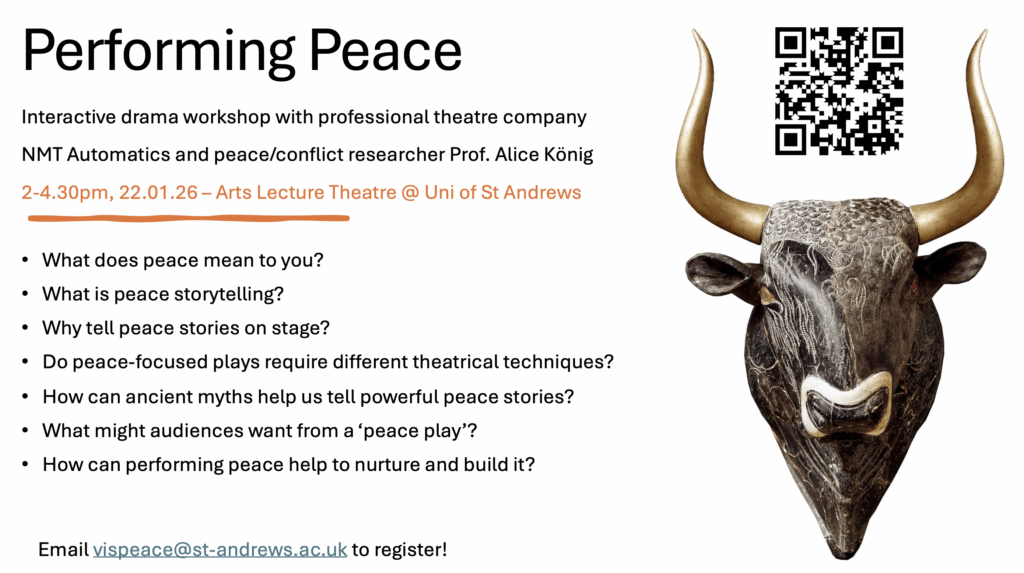
If these questions pique your interest, email [email protected] to sign up! You can read more about the workshop, and NMT Automatics’ new ‘peace play’, here.
Teaching Ancient War and Peace
As outlined here, an enhanced approach to teaching ancient war and peace is desirable for many reasons, not only to equip students of Classics to visualize ancient warfare and peacekeeping/peacemaking in more holistic ways but also to contribute to wider war and peace literacy. Our series of online workshops aims to bring together experts on war and peace (working within and beyond Classics) with experts on pedagogy (from the school sector, peace education institutes, and pedagogic studies) to set the agenda for a five-year research and impact project, which will produce publications, develop training materials, design and pilot new teaching resources, and contribute to curriculum development and policy-making within Classics and other related disciplinary areas. Ranging across primary, secondary and tertiary education sectors, it aims to lay the groundwork for more focused research in subsequent years.
To register for Teams links for these online workshops, please contact Prof. Alice König at [email protected].
26th November 2025, 2-5pm GMT
- 2-2.30: Everyday Militarisms in Children’s Learning Worlds (Jana Tabak, State University of Rio de Janeiro)
- 2.30-3: Approaches to Teaching Violence in the University Classroom (Fiona McHardy, University of Roehampton)
- 3.30-4: Peace Education: key tenets (Isabel Cartwright, Peace Education Programme Manager, Quakers in Britain)
- 4-4.30: Teaching Conflict Resolution through Ancient Texts: A Peacebuilding Approach in the Colombian and Amazonian Context (Ronald Forero-Álvarez and Rafel Uribe-Neira, Universidad de La Sabana, Chía, Colombia)
1st December 2025, 2-5pm GMT
- 2-2.30: Thucydides: if it’s not broken, don’t fix it (Steve Matthews Royal Grammar School High Wycombe)
- 2.30-3: Foregrounding Memnon and Modern Eritrea (Mai Musié, Swansea University)
- 3.30-4: How to teach gods of war differently (Susan Deacy, Bristol/Institute of Classical Studies)
- 4.30-5: Ancient Warriors, Modern Cemeteries (Matthew A. Sears, University of New Brunswick)
10th December 2025, 2-5pm GMT
- 2-2.30: The Battle of Marathon in Modern Young People’s Literature (Sonya Nevin, Hughes Hall, Cambridge)
- 2.30-3: Teaching ancient violence and trauma: two case studies from epic and historiography (Elina Pyy, University of Helsinki and Benjamin Jerue, San Jorge University)
- 3.30-4: Teaching sexual violence in ancient warfare (Hannah-Marie Chidwick, University of Bristol)
- 4-4.30: The girl went all unwilling: what Briseis can teach us about survival (Caroline Bristow, University of Cambridge)
Teaching Ancient War – roundtable discussion 1
Current approaches, what works well, what could be different?
Online consultation: Weds 29th January 2025, 1-2pm
- Where/when is ancient war taught in your curriculum?
- How does ‘war’ get defined?
- Which wars/which aspects of war do you focus on? Who takes centre-stage?
- What/who determines that (e.g. staff-choice, exam requirements, available sources/textbooks?)
- What are the strengths of the current approach?
- What are the challenges/gaps/things you would like to change?
Teaching Ancient War’s Aftermath – roundtable discussion 2
Current approaches, what works well, what could be different?
Online consultation: Mon 24th February 2025, 1-2pm
- Where/when is the aftermath of ancient warfare taught in your curriculum?
- Which aspects of war’s aftermath (e.g. political developments, economic issues, physical/mental trauma, forced displacement, etc) get discussed?
- What/who determines that (e.g. staff-choice, exam requirements, available sources/textbooks, teaching traditions, contemporary events?)
- What are the strengths of the current approach?
- What are the challenges/gaps/things you would like to change?
Teaching Ancient Peace and Peacebuilding – roundtable discussion 3
Current approaches, what works well, what could be different?
Online consultation: Weds 26th March 2025, 4-5pm
- Where/when is ancient peace or peacebuilding taught in your curriculum?
- How do ‘peace’ or ‘peacebuilding’ get defined? (e.g. interstate conflict resolution, the absence of violence, physical rebuilding, personal healing, inner wellbeing?)
- Which examples/aspects of peace or peacebuilding do you focus on? Who takes centre-stage?
- What/who determines that (e.g. staff-choice, exam requirements, available sources/textbooks?)
- What are the strengths of the current approach?
- What are the challenges/gaps/things you would like to change?
Learning about ancient and modern war and peace in dialogue – roundtable discussion 4
Online consultation: Mon 28th April 2025, 1-2pm
- Do you draw connections between ancient and modern war/peace in your teaching?
- How can ancient and modern conflict/peace histories best inform each other?
- What are the challenges?
- What are the opportunities?
- What structures or resources would need to change to facilitate more of this?
- What can Classical Studies/Classics/Ancient History learn from approaches to teaching war/peace in other subject areas?
- How can Classical Studies/Classics/Ancient History help inform the teaching of war/peace in other subject areas?